
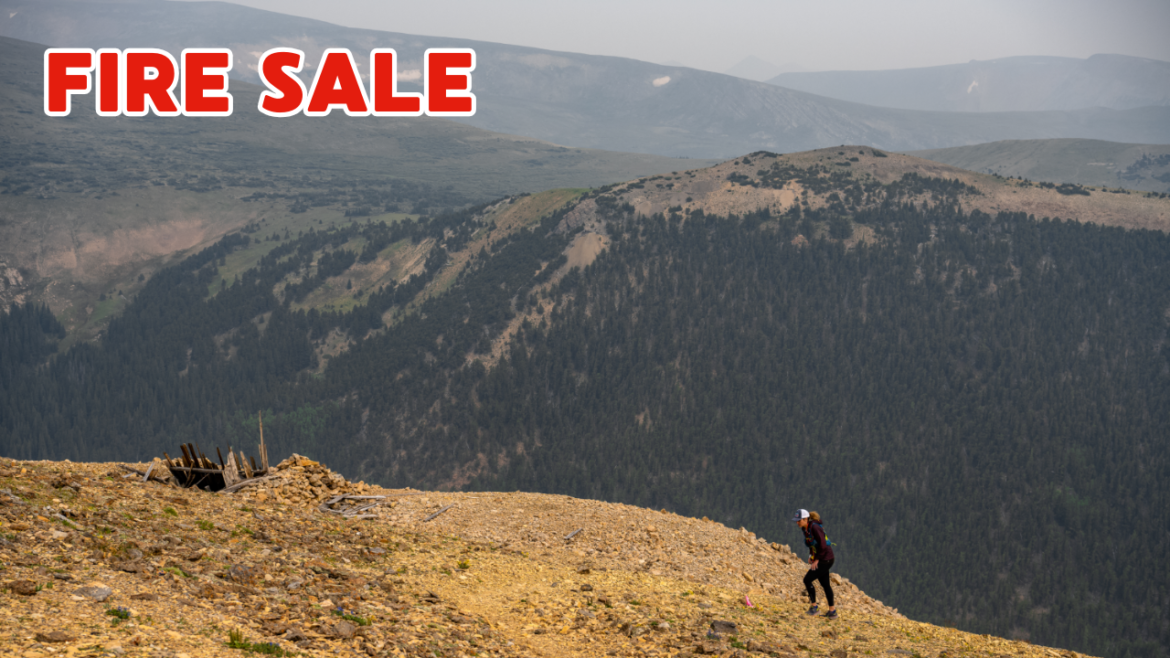
CONTINUED DISCOUNTS OFFERED AT HPRS
HPRS is proud to continue offering discounts to fire-affected runners from throughout the greater trail and ultra community. Here is how it will work:
Runners registered for any North American race canceled due to wildfire or poor AQI (150 or above) due to wildfire smoke will be afforded an opportunity to register for HPRS’s 2026 Sheep Mountain Trail Runs, Sangre de Cristo Trail Festival, and Indian Creek Trail runs. Runners will be required to provide proof of their original race’s cancellation and of their registration for the event via email ([email protected]). Upon receipt of this proof, HPRS will provide runners with a discount code to register for the HPRS event of their choice. Runners may use their canceled race once for one HPRS discount code (no multiple uses of the same cancellation).
If a runner is registered for any North American race that is scheduled to occur despite high AQI (150 or above), despite wildfire in the race’s near vicinity (within a 20-mile radius of greater than 50% of the course) (Ex: Leadville 100-Mile), or scheduled to occur albeit with a heavily altered course due to wildfire, we offer the same discounts as above. In this case, the runner must provide proof via email ([email protected]) of the events’ anticipated AQI, or the name of the nearby fire, or proof that the course is being altered, AND proof of their withdrawal from the scheduled event to obtain the HPRS discount.
As an example, if you are currently registered for the Leadville 100-Mile, which is in the process of redesigning its course, so long as you provide HPRS with proof of your withdrawal from running in this year’s Leadville 100-Mile, we will provide you with a code to register for an HPRS event of your choosing at the discounted rates below.
Registration Fees for “Fire Runners” Moving Forward:
Sheep Mountain Trail Runs – August 1 in Fairplay, CO
50 Mile = $140 ($40 off)
50k = $110 ($40 off)
Half Marathon = $60 ($40 off)
Sangre de Cristo Trail Festival – September 26-27 in Westcliffe, CO
8 Mile = $40 ($30 off)
27k = $60 ($40 off)
50k = $110 ($40 off)
50 Mile = $140 ($40 off)
100k = $150 ($70 off)
100 Mile = $200 ($175 off)
Indian Creek Trail Runs – October 17 in Sedalia/Littleton, CO
5 Mile = $30 ($30 off)
15 Mile = $60 ($40 off)
55k = $110 ($40 off)
50 Mile = $130 ($40 off)
The Fine Print:
- All HPRS t-shirt and award deadlines remain intact. We will not be buying extra shirts or awards in bulk. Please try to register before the t-shirt and award deadlines published on our website to secure a shirt and a finisher’s award. Fees are not further discounted due to a lack of a shirt or award.
- All HPRS Refund, Deferral, Bib Transfer, and Credit policies, as well as Force Majeure Related Refund and Credit policies, remain intact. Should HPRS cancel or alter an event due to wildfire or AQI, these policies will be enacted as written. HPRS does not provide refunds, in full or partial, for any reason.
- Race day registration will be welcome only as space allows. Traditionally, we do not sell out Sheep Mountain or Sangre de Cristo and have at times sold out Indian Creek. A first-come, first-served wait list may or may not be implemented. HPRS will update our website and Runsignup with the most up-to-date race day registration information. To receive the discount, runners will still be required to show proof as detailed above, either via email or in person at check-in.
- We encourage all runners to get to know HPRS via our website prior to making the decision to run with us. We’re different, and we love it. If we don’t sound like your jam, we encourage you to explore the many other events in our area that would be more than happy to have you.
A PERSPECTIVE
This summer, Colorado and other states in the American West are experiencing extreme fire conditions. Unfortunately, this has increasingly become our reality over many concurrent years.
Here in Colorado, we had an unusually dry winter, which led to one of the worst ski seasons on record. Beyond affecting ski season, the lack of snow reduced the snowpack, which the entire state and others rely on for their water needs year-round. What little snowpack we had melted out months earlier than usual. Therefore, we are experiencing a renewed period of drought and praying for the “Super El Niño” to possibly deliver an increased monsoonal flow and an epic winter to come.
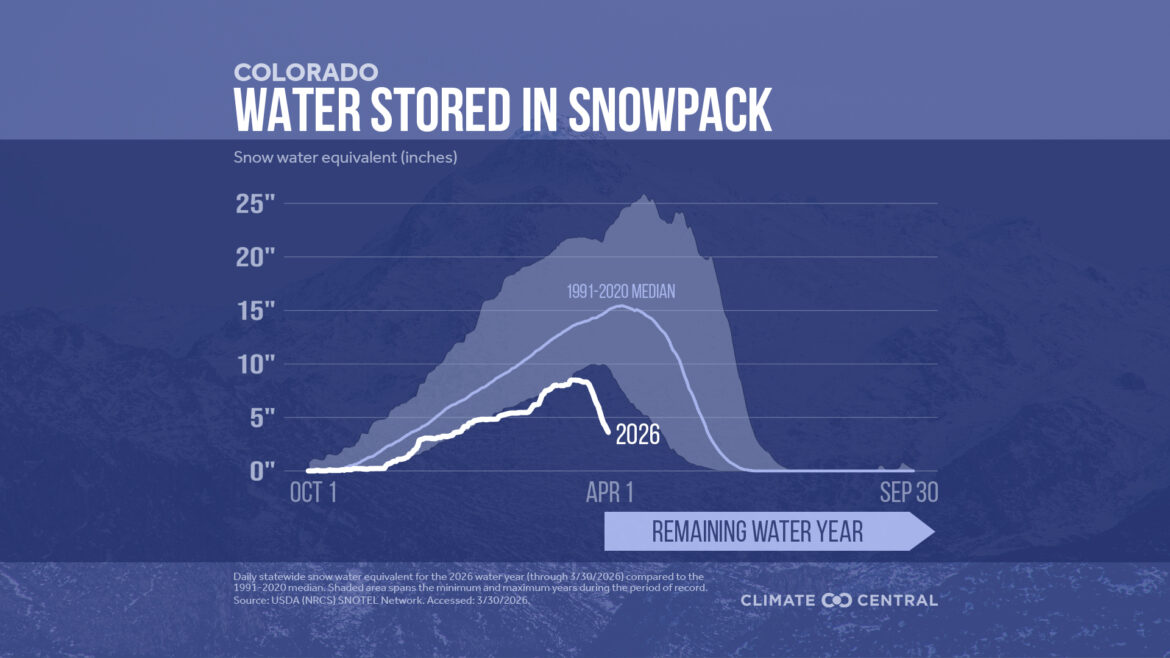
Until the rain arrives, the situation on the ground remains dire, with little relief in sight. It’s dry out there. In Denver, it reached 80 degrees multiple times in March, a month earlier than any other time in recorded history. It feels like it’s been 90 to 100 degrees for months, with temps even reaching the 80s more often than normal in the mountains. Many of us living in the Front Range are currently under drought restrictions. A few good rainstorms won’t nearly be enough to get us out of the current situation with flammability. We need a period of prolonged soaking rains.
Naturally, those of us who live here braced for what could be a historically awful fire season. While it’s certainly been bad, it could, of course, be worse.
Colorado is a massive state. You could fit all of New England’s land mass (ME, MA, NH, VT, CT, RI) inside of Colorado 1.65 times. More simply, Connecticut alone fits into Colorado 22 times over. A lot of times, when the news reports a fire in Ouray, Colorado, many people think it’s on Denver’s doorstep. As the crow flies, the Ouray fire is 172 miles southwest of the westernmost border of the Denver Metro. The reality on the ground in the southwest corner does not match what is occurring in the northeast corner.
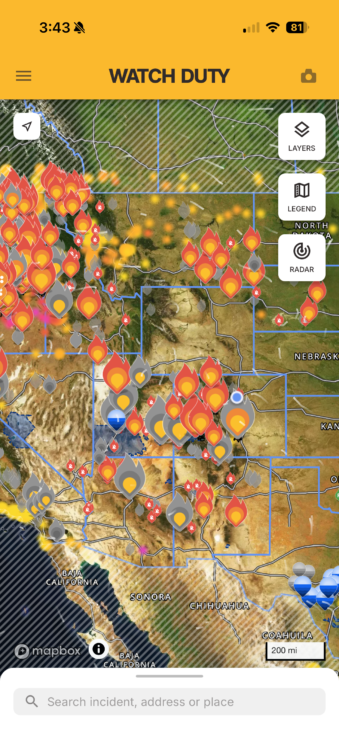
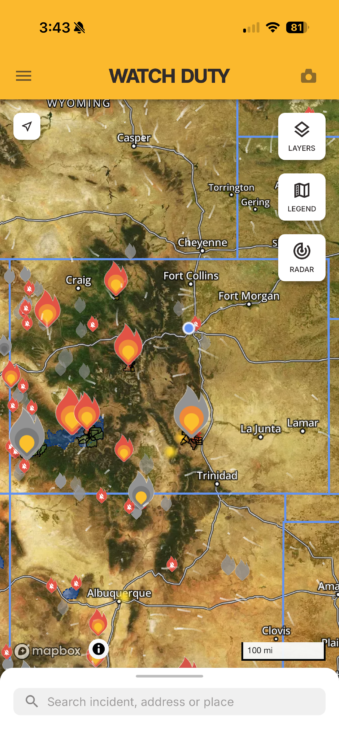
Folks also love to grab a screenshot of the map on the Watch Duty app to show that all of Colorado is on fire. Of course, they’re so zoomed out that you cannot grasp the true scale of the fires or where they are. Zooming in shows you that, while yes, there are many fires in Colorado at this time, they’re all pretty spread out across our state. Perspective certainly matters. Not all of Colorado is on fire. Generally, all of Colorado is affected by smoke from fires. That smoke is from fires across the American and Canadian West. Most folks also believe that Colorado has 4 borders. It has 697 distinct sides, most certainly not a square.
CANCELLATIONS
Earlier this month, the Ouray 100-Mile made the difficult decision to cancel its event about a week and a half out from the start date. The race director gave a very detailed and professional narrative discussing everything that went into his decision. Meanwhile, the Hardrock 100, which travels into Ouray, decided to continue without delay, 100% as planned. Hardrock also provided narratives discussing what went into their decision.
While both events took place in Ouray, the effects of the fire were drastically different. Many parts of the Ouray 100 course were burned by the Gold Mountain Fire, a fire that did not at all burn the Hardrock course. Rerouting their event on such short notice was nearly impossible for Ouray 100. Hardrock mostly focused on Air Quality due to smoke, which was primarily from the Ferris Fire, burning 53 miles to the southwest, and the primary impact on their event.
It is incredibly important to maintain the perspective that Hardrock and Ouray 100 are two separate events, with different leadership structures, significant differences in support, and very different realities for participants, crews, and spectators. What is the best decision for one will not be the best decision for the other.
108 miles away to the Northeast, the Willow Fire burns just outside of Leadville. The fire is burning on the east and northeast slopes of Mounts Massive and Elbert. This will heavily impact August’s Leadville 100-Mile, which takes place on roads and trails within the burn scar and zones with mandatory and ongoing pre-evacuations. The Lifetime Race Series in Leadville was slated to host their annual Silver Rush event on the same weekend as Hardrock (one week prior to Ouray 100) and ultimately decided to cancel. This decision was made because the city of Leadville was under a pre-evacuation notice, as were parts of the 50-mile course. The 2026 Trans Rockies Run (Pass to Pub) was also canceled due to the Willow Fire and its impact on the local community, air quality, and emergency responders in the Leadville, Colorado, area.
Below, we go a little bit deeper into the realities of cancellation for those who want to engage further.
HPRS RESPONSE
At HPRS, we get it. You train for many months for your goal race, and when it gets canceled, it rips your heart out. When you consider travel plans and the costs involved, the logistics of traveling with family and more, it’s a gut punch. We can all pontificate on whether a race made the right decision or not, because at the end of the day, you want to run.
Our 12th Annual Silverheels Trail Runs took place on July 10-11, 2026. This was the same weekend as the scheduled Hardrock 100 and the canceled Silver Rush event in Leadville. It was also one week prior to the canceled Ouray 100. When we heard of the cancellations of Ouray and Silver Rush, we knew that there was one thing to do. Support the greater community of trail and ultramarathon runners by opening our doors.
At $500-$525, the Ouray 100-Mile is one of the most expensive in our state. Upon cancellation, they offered runners a $150 credit toward their 2027 race entry fee. Runners were also required to satisfy an 8-hour volunteer requirement as a condition of entry. The Silverheels 100-Mile opened with an entry fee of $350, the 4th lowest in the state, and on race day reached tier-three pricing of $385. Silverheels also has an 8-hour volunteer requirement as a condition of entry. Knowing Ouray runners had already satisfied the volunteer requirement for their original event, we accepted that same requirement for Silverheels. Understanding how much money they had tied up in and lost at Ouray, we offered them to register for Silverheels at 50% off ($190), so long as they also met all other qualifications for entry.
Silver Rush was canceled on the Tuesday of race week, with many runners already having traveled to Colorado to acclimate for the event. Silver Rush offered runners a 100% refund, 100% deferral to the 2027 running of the event, or 100% deferral to any other Lifetime Race Series event. Silver Rush features 50-mile and 15-mile distances. We also opened our doors to displaced Silver Rush runners with discounted race entry fees. They could sign up for our Silverheels 100k at 35% off, the 50-mile at 39% off, the 60k at 40% off, the 19-mile at 50% off, and the 10-mile at 50% off.
The Willow Fire in Leadville was 35 miles away from the westernmost part of the Silverheels event. Between our event and the fire is the Mosquito Range with multiple 14,000+ foot mountains, the city of Leadville, and the town of Breckenridge. Our biggest concern was air quality. Using advanced online Air Quality monitoring and forecasting products, we determined that air quality would never exceed 75 (Moderate) during our event. We experienced AQI levels below 60 (Good) for most of our event.
In total, we welcomed 81 displaced “fire runners” (“fire refugees”) to the Silverheels event. The 12th Annual Silverheels Trail runs became the largest event HPRS has ever held in Colorado, setting HPRS records for race-day registrants, total race participants, and total participants across two days. Most importantly, we provided these runners with the opportunity to run as planned and enabled many to experience HPRS for the first time.
HPRS celebrates itself as a “people over profit” series of runs whose primary focus is on radical inclusivity and personal growth through athletic endeavors. Where “the human” is more important than “the race.’ We know many will see us merely as “opportunists,” but what matters most is intention and heart. In our hearts, we built HPRS to celebrate the communal roots of our sport, and we choose to be runners helping runners in whatever ways that may manifest.
MORE PERSPECTIVE
It is important to note that one of the most difficult decisions for race directors involves whether to cancel a race. Many months of work go into planning and executing every aspect of an event. The heart and soul of a race director is as invested in the event as the heart and soul of the many runners who are training to participate. We assure you that the race director is as crushed by a cancellation as runners are. Frankly, it is an increasing reality in our sport that race directors choose to soldier forward without doing a proper risk assessment that not only includes all runners, crews, pacers, spectators, staff, and volunteers, but also local EMS and resources who will already be impacted by significant emergency events like wildfire or severe weather. There are an incredible number of factors and people who need to be considered when making the ultimate decision.
Race directors also put considerable energy and creativity into course design. Altering the intended route to go around questionable areas, regardless of their severity, which could include issues not limited to wildfire, flooded trails and/or roadways, snowpack, known and unknown trail closures and/or reroutes, wildlife concerns, vehicular accidents, active shooters, and perhaps non-race-related active search and rescue operations, comes with serious logistical disruption. It’s not as simple as just moving the lines on a map. There are countless considerations associated with the rules and regulations outlined in a race director’s permits, which may preclude an easy, quick, or even possible fix.
In this article, we highlighted the differences between what Ouray 100 and Silver Rush offered their runners as a result of their respective cancellations. This was not done to embarrass or denigrate either race. It was done to highlight that not every race operates within the same financial structure. Ouray hosts two events per year: its July 100-mile and September 50-mile. Between these two events, they welcome around 215 runners in total. The Leadville Race Series hosts 4 running events in Leadville each year (Marathon & Half in June, Silver Rush in July, 10k in August, and 100-Mile in August). Between these run events alone, they welcome over 2000 total runners. They also host a run event in Austin, TX, as well as seven other bike events.
There is a stark contrast between these two events. Lifetime has a financial structure and stability that Ouray does not. Lifetime has multiple events they can spread “the hit” of a runner’s deferral around to. Lifetime is also pulling in tens, if not hundreds, of thousands of dollars in sponsorship that Ouray most certainly is not. The Leadville Race Series also has the financial backing of a massive corporation, Lifetime Fitness, which owns and operates the series, while Ouray is privately owned by a tax accountant. While it is certainly easy to couch quarterback the differences in what was offered to runners of each event, context and perspective certainly matter. Many lessons were learned about refunds during COVID, and those realities have not changed for race directors or runners. Just as every race handled COVID differently, and to the best of their ability, the same is true for races affected by wildfire.
